The admission letter is in your hand and the year is decided. What stands between you and Guangzhou is not one big task but a sequence of small ones — paperwork, flights, housing, money, packing — and each has its own week. This is the checklist, in the order the weeks actually go.
So, you did it: the University has accepted your Application, and you are officially China-bound. Congratulations are in order — and then, once the excitement settles, the questions arrive. What visa? What do I pack? How do I even pay for things there?
Feeling overwhelmed is normal. Every Applicant we have worked with has stood exactly here. The trick is to give each task its own runway, so here is the whole run-up as a timeline.
Part one: the paperwork (3–4 weeks before you fly)
This is the critical stretch. Be organized and start early.
The admission letter and official documents
- Secure your admission letter. This is the University’s official acceptance, and it usually reaches you by University email. Check your spam folder, and write to us if it has not arrived.
- JW201 or JW202 form — for Study Programs longer than 180 days. A crucial document issued by the Chinese authorities and required for the student visa application. The University sends it together with your admission letter. Print it, and make copies.
- DQ form — for Study Programs shorter than 180 days. The short-program counterpart, with the same treatment: print it, copy it, keep it with your documents.
The student visa: X1 or X2
This is the big one. Start the application as soon as your admission letter and form are in hand.
- X1 visa: for Study Programs longer than 180 days. You enter China on it, then have 30 days to apply for a Temporary Residence Permit.
- X2 visa: for Study Programs shorter than 180 days.
Processing usually takes about a week, and you will receive an email once your visa application is approved.
Check the website of the Chinese embassy or consulate in your country for exact requirements, book your appointment early, and double-check every document before you go.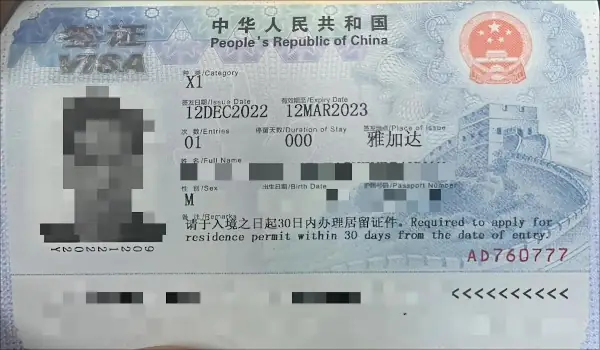
Part two: getting practical (2–3 weeks before you fly)
With the paperwork out of the way, the real-world logistics.
Book your flight
Book as soon as your visa is approved — booking ahead usually saves real money. Watch the luggage allowance; international flights enforce it strictly. There are two good ways into Guangzhou: fly directly into Guangzhou Baiyun International Airport (CAN), or fly into Hong Kong and continue to Guangzhou by high-speed train or ferry.
Arrange your accommodation
- On-campus dormitory. For most students this is the easiest choice, but be warned: rooms are in high demand, and you need to apply the moment applications open. The University is in charge of housing, so we cannot guarantee a room — acting fast is the strategy.
- Off-campus apartment. For students who want more independence, we can share a list of suggested apartments and local housing resources. It is often easier to arrange after you arrive and can see places in person — consider a hotel for your first week.
To make sure a dormitory meets your expectations, consider booking a hotel for your first night or two. It gives you time to inspect the room in person before moving in — and if it is not suitable, you have a comfortable base while you arrange something else.
Money matters
- Bank account. Consider opening an account at a Chinese bank branch in your home country before you leave. The most recommended banks are Bank of China (BOC) and Industrial and Commercial Bank of China (ICBC), which have many international branches. Their debit cards work for withdrawals the day you land — ask the branch staff about accounts for international students.
- Cash. Exchange a little of your currency into RMB to cover the first days — taxi, food, the small things. Cash still works, but daily life in China runs on mobile payment.
- Cards. Notify your bank that you are traveling. You can link an international credit card to WeChat Pay and Alipay, but be aware that many local merchants can only accept payment from a pre-loaded RMB balance in the app’s wallet, not directly from a foreign card.


Part three: the final week
Almost time. The last touches that make arrival smooth.
Pack the smart way
- Documents — carry-on only. Passport, visa, flight tickets, admission letter, JW201/JW202 or DQ form, and copies of everything. Bring extra passport-style photos.
- Electronics. Laptop, phone, chargers, a good power bank (make sure it is CE-certified — airlines check), and a universal travel adapter.
- Clothing. Pack for the season you arrive in, and no more. Clothes for other seasons are very affordable in China.
- Personal items. A starter kit of your favorite toiletries, any prescription medication (with a doctor’s note), and a small first-aid kit.

Tech prep: the non-negotiables
Do this before you leave your home country.
- Install a VPN. Google, Facebook, Instagram, and WhatsApp are blocked in mainland China. A Virtual Private Network is how residents and students access them — install it on your phone and laptop before you fly.
- The essential apps. Download WeChat 微信 and Alipay 支付宝 — the super-apps used for everything from messaging to paying for a bottle of water. Add Baidu Maps 百度地图 for navigation and Didi 滴滴出行 for ride-hailing.
- Android: the Google Play Store is blocked in China. A popular, safe alternative is the Tencent Appstore 应用宝, which carries all the essential Chinese apps.
- iPhone: your App Store works, but some apps exist only in the Chinese store — you may need to switch your store’s region to Mainland China in settings. Remember to switch it back later to update the apps from home.
A word on health
China’s climate can be a real change from yours. Keep your sleep, eat properly, and get regular exercise in the run-up — arriving rested is worth more than any item on the packing list.
You’re ready
Preparation is the difference between a stressful move and a smooth one. Follow the checklist week by week, and by departure day the logistics are quiet — which leaves your attention where it belongs: on the year ahead, the language, and the city waiting at the other end of the flight.
When you have questions, write to us; that is what we are here for. And when you are ready to see the shape of the year itself, the journey section on the main page walks it end to end.
欢迎来到中国! — Welcome to China.